A2 Ghee vs Regular Ghee: Is A2 Desi Ghee Better?
Is A2 desi ghee better than regular ghee? The difference is the breed of cow and the protein in her milk. Whether that matters to you depends on things worth knowing first.
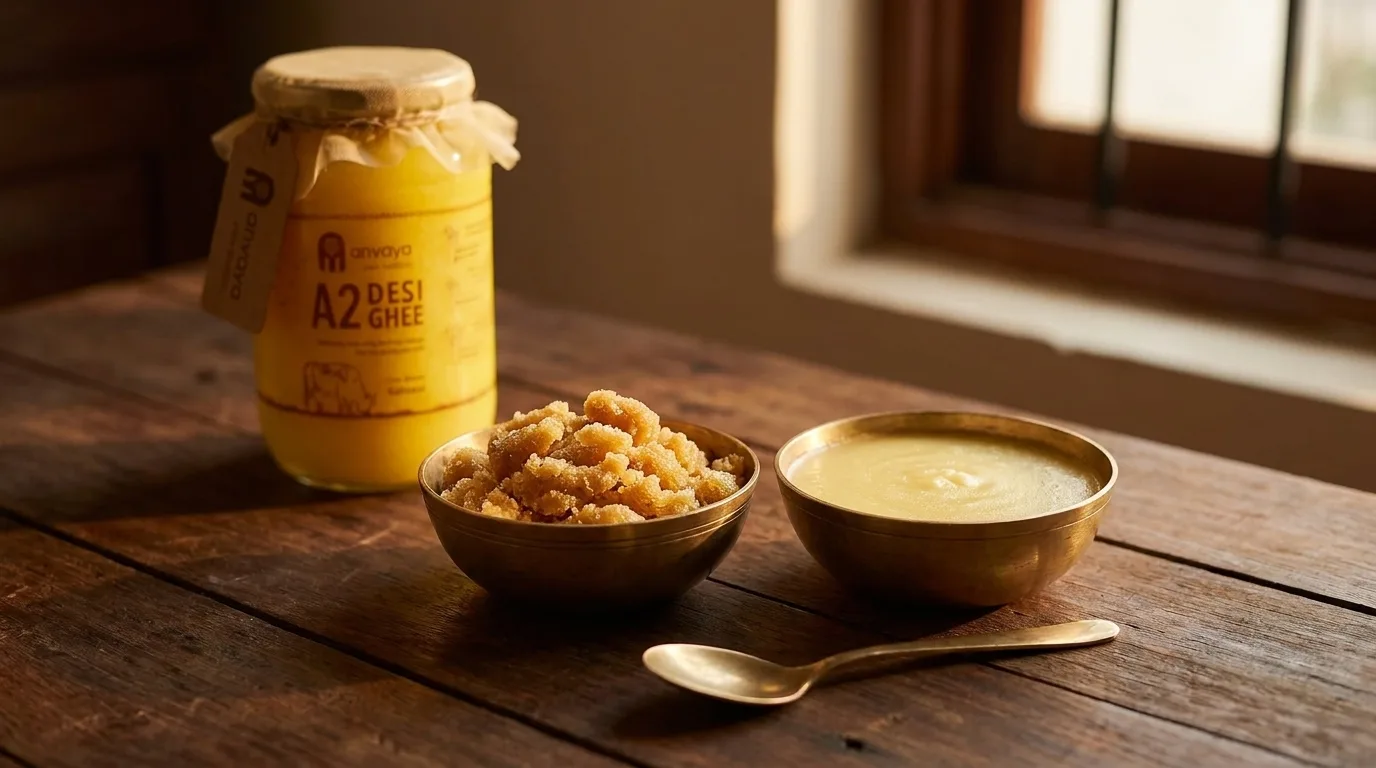
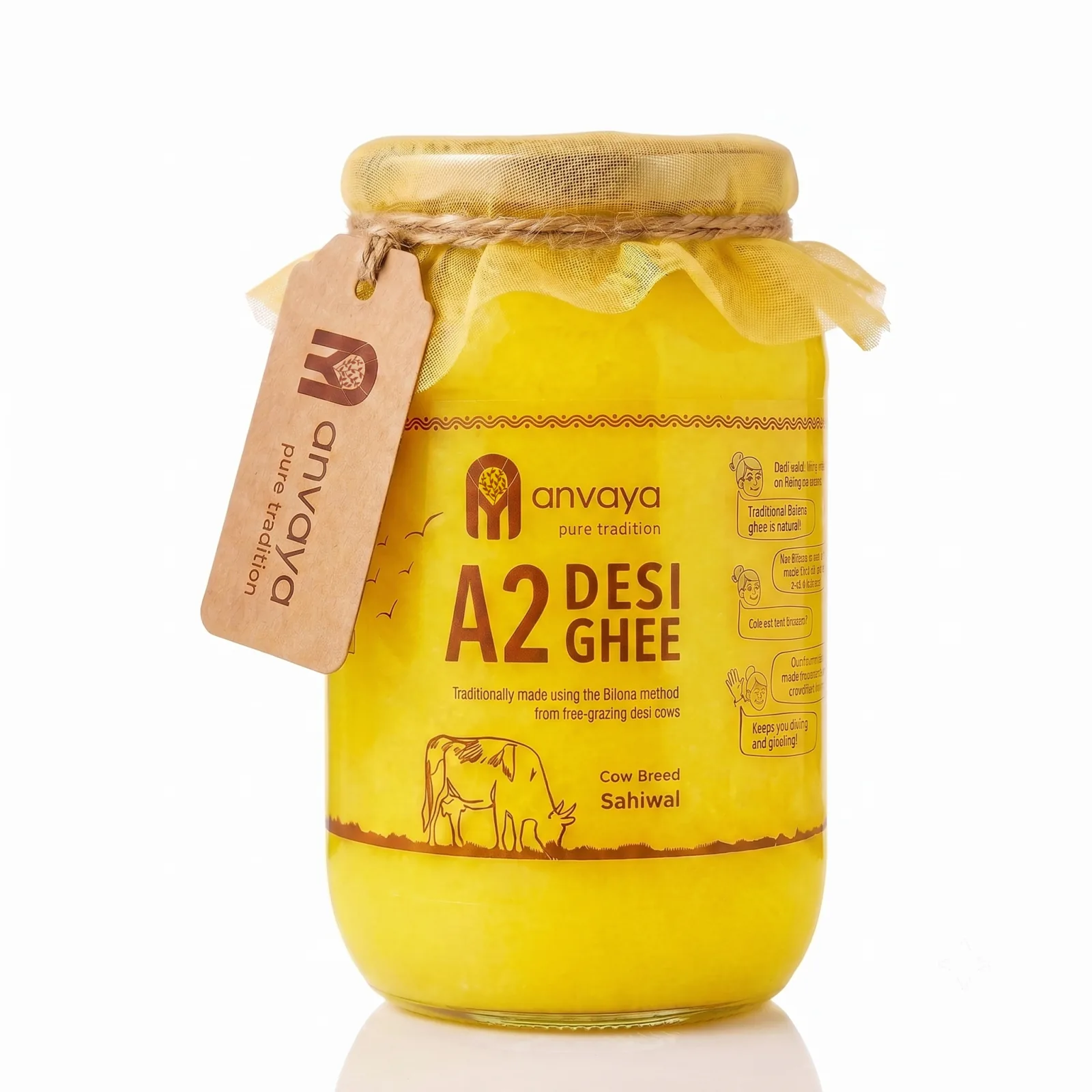
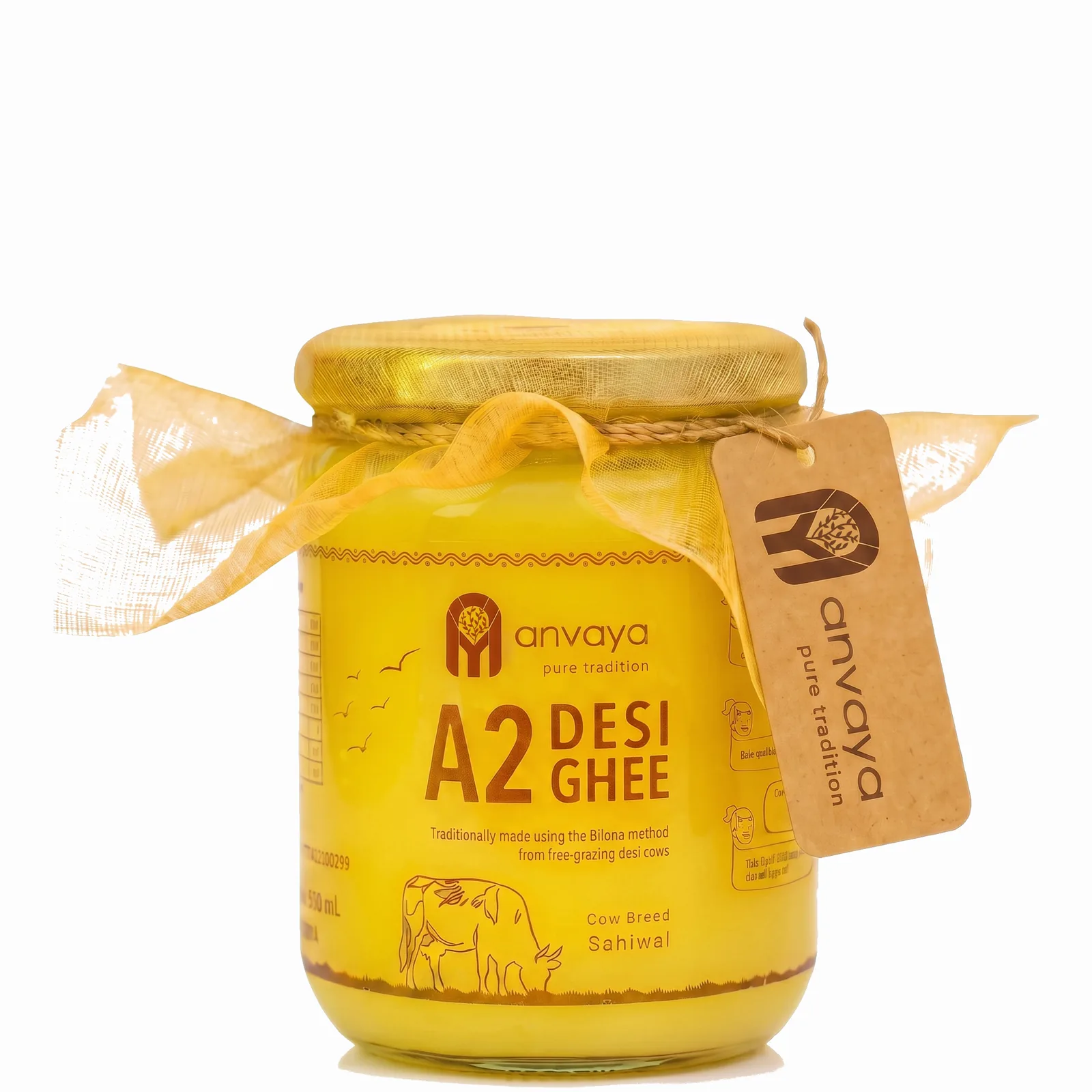
A2 ghee is made from the milk of indigenous cows, whose milk carries only the A2 form of beta-casein. Regular ghee is usually made from crossbred or buffalo milk, which carries a mix of A1 and A2. That is the entire difference at the protein level. Everything else people claim about it is either about the making, or about marketing.
We sell A2 ghee. We also think you should know what you are actually buying.
Is A2 ghee better than regular ghee?
Not in any way that has been proven for health, and we do not claim it is. What A2 ghee reliably tells you is provenance: a native breed, usually from a smaller herd. Whether it tastes different depends mostly on how it was made, curd-churned or cream-separated, and that is a separate question from A2. If provenance and that taste matter to you, the premium buys something real. If you want a clean cooking fat, regular ghee does the job.
| A2 ghee | Regular ghee | |
|---|---|---|
| Milk | Native breeds such as Sahiwal and Gir, A2 beta-casein only | Usually crossbred or buffalo milk |
| Protein left in the ghee | Very little, most is cooked off | Very little, most is cooked off |
| Method | Depends on the maker, so ask whether it is curd-churned | Usually cream separated by machine |
| Proven health advantage | None established | None established |
Where the two proteins come from
Beta-casein is one of the main proteins in milk. Most Indian native breeds, Sahiwal, Gir, Rathi, Tharparkar, Kankrej, produce the A2 variant. Holstein Friesian and Jersey, the breeds most Indian dairies crossbred into their herds from the 1970s onward, commonly carry the A1 variant.
A1 and A2 differ by one amino acid at position 67 of the chain. That single difference changes how the protein breaks down during digestion. A1 can release a peptide called BCM-7. A2 does not.
That is where the settled science ends and the argument begins. Research on whether BCM-7 matters for human health is ongoing and mixed. We make no health claims about our ghee, and you should be careful with anyone who does.
The part nobody mentions
Ghee is almost entirely fat. During clarification, the milk solids, and therefore most of the protein, are cooked off and strained out.
So the A1 versus A2 distinction is a claim about the milk more than about the finished ghee. If someone tells you A2 ghee is easier to digest because of the protein, ask them how much protein they think is left in a fat.
What A2 does reliably tell you is provenance. It means the ghee came from a native breed, and native breeds are usually kept in smaller herds, fed differently, and milked less. That is a real signal. It is just a signal about farming, not about biochemistry.
What actually changes the taste
Two things, and neither of them is the protein.
The first is the method. Bilona ghee starts with curd. The milk is set overnight, churned, and the butter that rises is cooked down. Commercial ghee usually starts with cream separated by machine. Curd-churned ghee tastes more complex and smells stronger, because fermentation happens before the fat is ever heated.
The second is the fire. Slow cooking over wood produces the grain that people call danedar. Fast industrial cooling produces a smooth, uniform paste. Neither is a fault. They are different products.
Price, plainly
A Sahiwal gives 8 to 12 litres a day in a good season. A crossbred Holstein can give 20 to 25. Curd-churning yields less ghee per litre than cream separation. It takes close to 30 litres of milk to make one kilo of ghee our way.
That arithmetic is the whole reason a 500 ml jar of ours is ₹1,500 before GST and a supermarket kilo is ₹600. We wrote out the full sum in why A2 ghee costs more.
Reading the shelf
Walk down a supermarket aisle and you will see three tiers. Vanaspati and blended fats, which are not ghee at all and are usually labelled to hint otherwise. Commercial cow and buffalo ghee from large dairies, made by cream separation at scale, which is honest food at an honest price. Then the small-farm tier, where A2 and bilona appear on the label and the price triples.
The first tier is the one to actually watch, because that is where the deception happens. The gap between tiers two and three is a question of taste and provenance, and reasonable people land on either side of it.
Desi ghee vs normal ghee
In most Indian kitchens, desi ghee simply means real ghee made from milk, as opposed to vanaspati or a blended fat. It is a word about the product. It does not name a breed or a method.
So when people compare desi ghee with normal or regular ghee, they are usually comparing two real ghees, one called desi and one from a large dairy. The words will not settle it. Three questions will: which milk, which breed, and curd or cream. An A2 label speaks to the milk and the breed. Bilona speaks to the method.
Who should skip it
If you cook with ghee occasionally and mostly want a clean cooking fat, buy a decent commercial brand and spend your money elsewhere. It will fry your food perfectly well.
If you are lactose intolerant, note that ghee is very low in lactose regardless of breed, so A2 is not the deciding factor there.
If you are buying A2 because you read that it cures something, please do not. Nobody should sell you food that way, us included.
Who it is for
People who cook with ghee daily and can taste the difference between curd-churned and cream-separated. People who want to know which farm and which breed their food came from. People who make halwa and want it grainy.
That is a narrower group than the market pretends, and we would rather have those customers than sell to everyone.
What about buffalo ghee
Buffalo milk has more fat than cow milk, and buffalo ghee comes out whiter, firmer, and blander. It is not inferior. It is a different thing, and in many parts of India it is what people grew up with.
The A1 and A2 argument does not apply to it in the same way, because buffalo beta-casein is its own variant. If someone is selling you buffalo ghee on an A2 platform, they are stretching a term past where it means anything.
How to check a claim
Anyone can print A2 on a jar. There is no A2 inspection regime in India the way there is for organic certification. So look for the specifics instead. Which breed. Which farm. Curd or cream. Is there a lab report, and can you read the actual document rather than a badge.
Ours is Sahiwal, from our own cows, curd-churned, and the reports are on the lab reports page. If a brand cannot answer those four questions, the A2 label is decoration.
So which ghee is best in India?
There is no single best ghee, and a brand that says its own jar is the best is selling, not answering. That includes us.
For everyday cooking on a budget, a decent commercial cow ghee is a sound choice. If you want A2 bilona ghee, the best jar is the one that answers the four questions above with a document, not a badge. We turned those questions into a buyer's checklist for A2 ghee.
Next: how to test ghee purity at home, or read about Sahiwal versus Gir.
Umesh Pratap Verma
Founder, Anvayapure
Founder of Anvayapure. Custodian of Ma Sumitra Devi Goshala in Uttar Pradesh, and the man who insisted on Sahiwal Bilona over shortcuts.