10 Benefits of A2 Ghee in Ayurveda
Ayurveda treats ghee as a carrier rather than a cure. Here is what the classical texts actually claim, and where those claims stop.
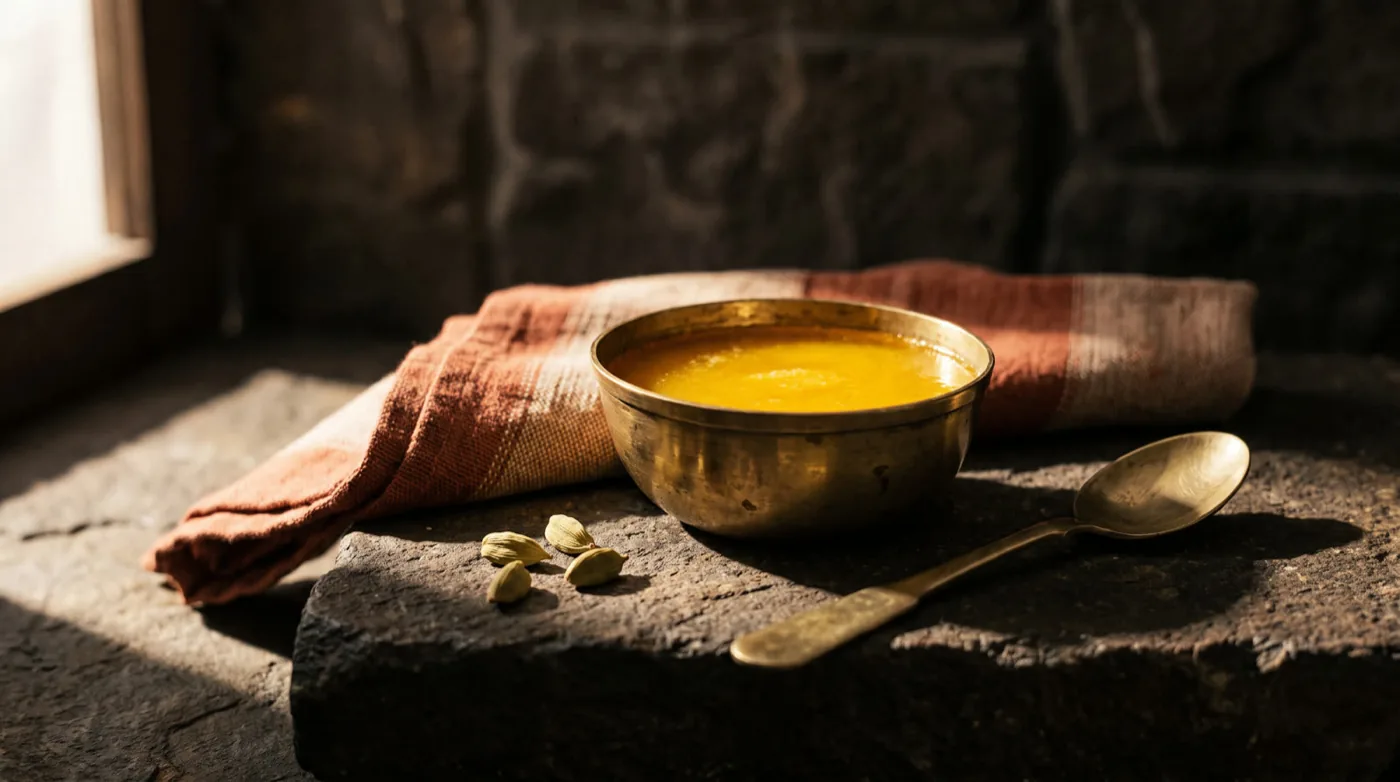
Ayurveda treats ghee as a carrier. Its job in the classical texts is to take other things deeper into the body, which is why medicines are given with it and why it opens Panchakarma rather than closing it. The ten uses below are what the tradition claims. They are old and they are consistent. They are not clinical trials, and this article does not pretend otherwise.
What A2 actually means
A2 refers to a variant of the beta casein protein in milk. Indigenous breeds like Sahiwal, Gir and Red Sindhi carry it. Most high-yield crossbred cattle carry A1 instead.
Worth knowing before you pay a premium: ghee is almost entirely butterfat, so very little protein of any kind survives into the jar. The A2 distinction matters much more in milk than it does in ghee. What you are really buying when you buy good ghee is the animal, the feed behind it and the method used to make it.
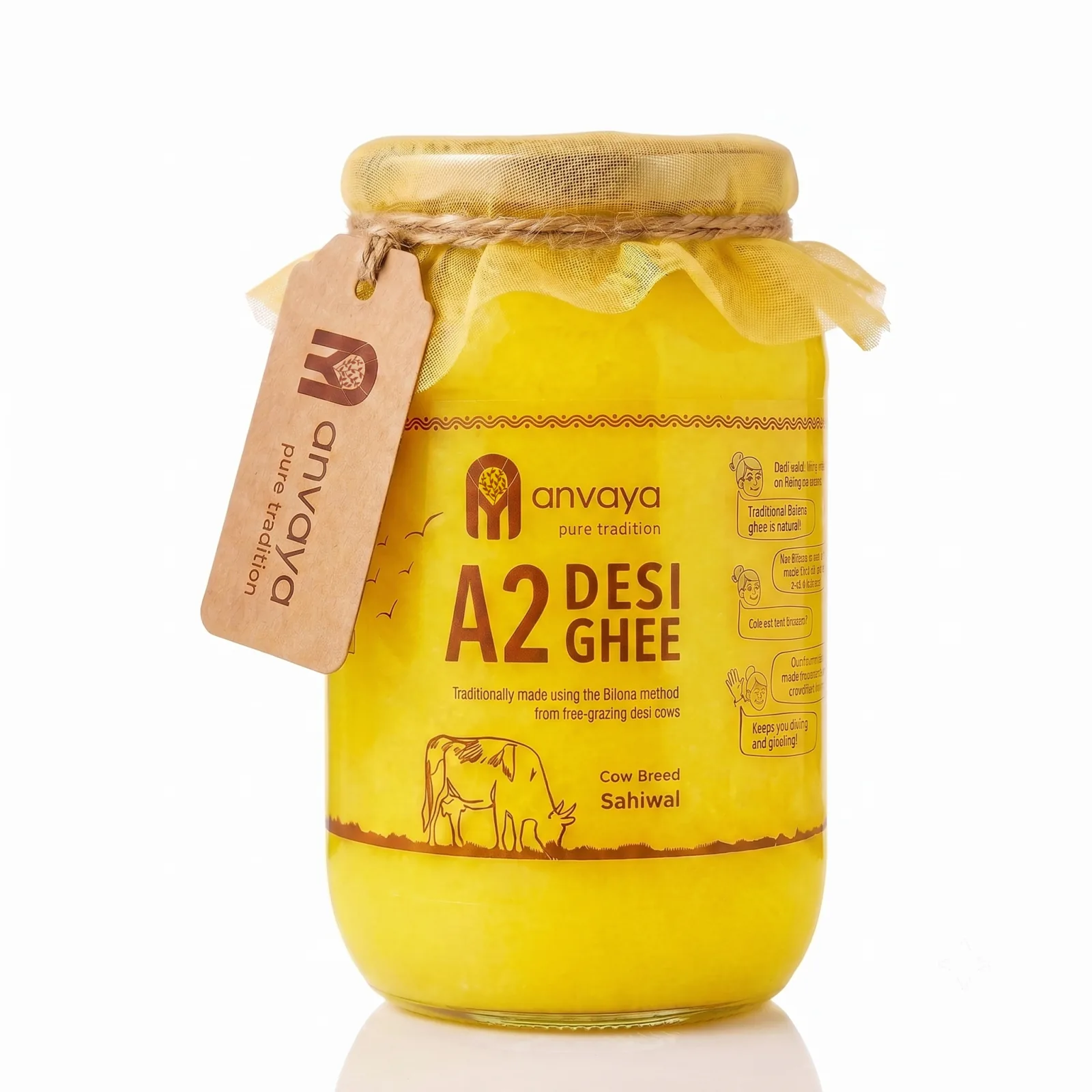
Ours is made from Sahiwal milk, churned from curd in a wooden bilona and finished on a wood fire.
1. Digestion, agni
The texts call ghee agni deepana, something that kindles digestive fire without aggravating pitta. Most other fats are said to dull agni. Ghee is the exception in that list, which is why it appears in daily food rather than only in preparations.
The traditional instruction is a teaspoon with the first meal, or on an empty stomach if you can take it that way.
2. Intellect and memory, medhya
Medhya rasayana is the category the texts use for anything associated with intellect and recall. Ghee sits inside it, usually as the base for a medicated preparation rather than on its own. Brahmi ghrita is the best known.
3. Vitality, ojas
Ojas is the Ayurvedic idea of vitality, understood as the end product of digestion working well. Ghee is described as an ojas builder. In practice that framing matters, because it means ghee is treated as something you eat every day in small amounts, not something you reach for when you are already unwell.
4. Joints and mobility
Snigdha, meaning unctuous, is the quality the texts attach to ghee. Joints are one of the places that quality is said to count. The same principle drives internal oleation before a cleanse.
5. Skin, twak
Ghee is used internally and externally in traditional skin preparations, and it is the base for a long list of medicated ghees meant for the skin. Shatadhauta ghrita, ghee washed a hundred times in water, is the classical example.
6. It suits all three doshas
Most foods pacify one dosha and aggravate another. Ghee is described as tridoshic, acceptable to vata, pitta and kapha when taken in moderation. That is unusual, and it explains why the texts treat it as a staple rather than a seasonal correction.
7. Eyes, netra prasadana
Ghee appears in traditional eye care, including netra tarpana, where warm ghee is held over the eye inside a ring of dough. That is a practitioner procedure, not something to attempt at home.
8. Preparation for Panchakarma
Snehana, internal oleation, is the preparatory stage before the main cleansing procedures. Ghee is the usual medium, taken in rising doses over several days. This is the clearest illustration of the carrier idea. The ghee is not the treatment. It makes the treatment possible.
9. Heat that holds
Ghee sits at roughly 250 degrees before it smokes, which is higher than butter and higher than most refined oils sold for frying. The water and milk solids that make butter burn have already been cooked out.
This one is not a claim from the texts. It is simply true, and it is the reason ghee survived in Indian kitchens as a cooking fat rather than only a ritual one.
10. Anupana, the vehicle
Anupana is the word for whatever a medicine is taken with. Ghee is one of the standard choices, selected when a preparation is meant to reach deeper tissue. Honey, warm water and milk are the others, each matched to a different intention.
Where the claims stop
None of the above comes from a controlled trial. Ayurveda is a system with its own internal logic and a very long record of use, and that is a real thing, but it is not the same kind of evidence as a clinical study. Anyone selling you ghee as a treatment for a named disease is going beyond both the texts and the science.
The nutritional facts are worth holding alongside the tradition. Ghee is close to pure fat and roughly two thirds of it is saturated. If you have been advised to watch saturated fat, ghee is not exempt from that advice. A teaspoon or two a day inside an ordinary diet is the traditional amount. It was never a large quantity.
If you are pregnant, managing a heart condition or on medication, ask a doctor rather than an article.
How to choose ghee that is worth the money
Four things are worth checking, and only one of them is usually printed on the label.
The breed. Sahiwal, Gir and Red Sindhi are the indigenous A2 breeds. If a seller will not say which, assume mixed.
The method. Curd churned, not cream separated. Bilona means the milk was set into curd first and the butter came out of that curd. Cream ghee is a different product made faster, and much of what is sold as bilona is cream ghee with a story attached.
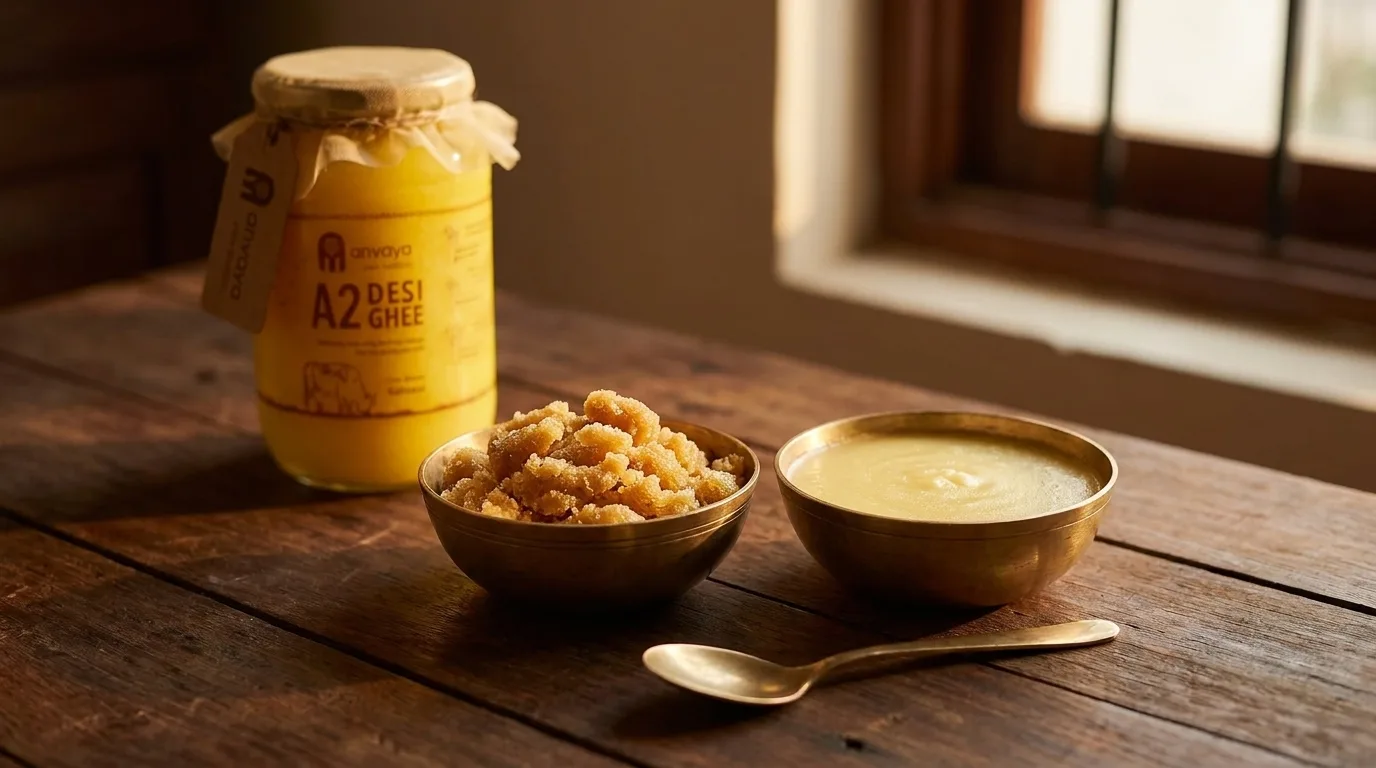
The grain. Danedar texture forms when ghee cools slowly after a slow cook. Industrial ghee is chilled fast and comes out smooth. Grain is a signal of method, not a defect.
The report. Almost every brand says lab tested. Ask to see the report. Ours are from a NABL-accredited food-testing lab and they are published in full on our Lab Reports page, including the ones that are simply unremarkable.
Anvayapure Editorial
Written by the Anvayapure team, on traditional food, cooking, and wellness.